

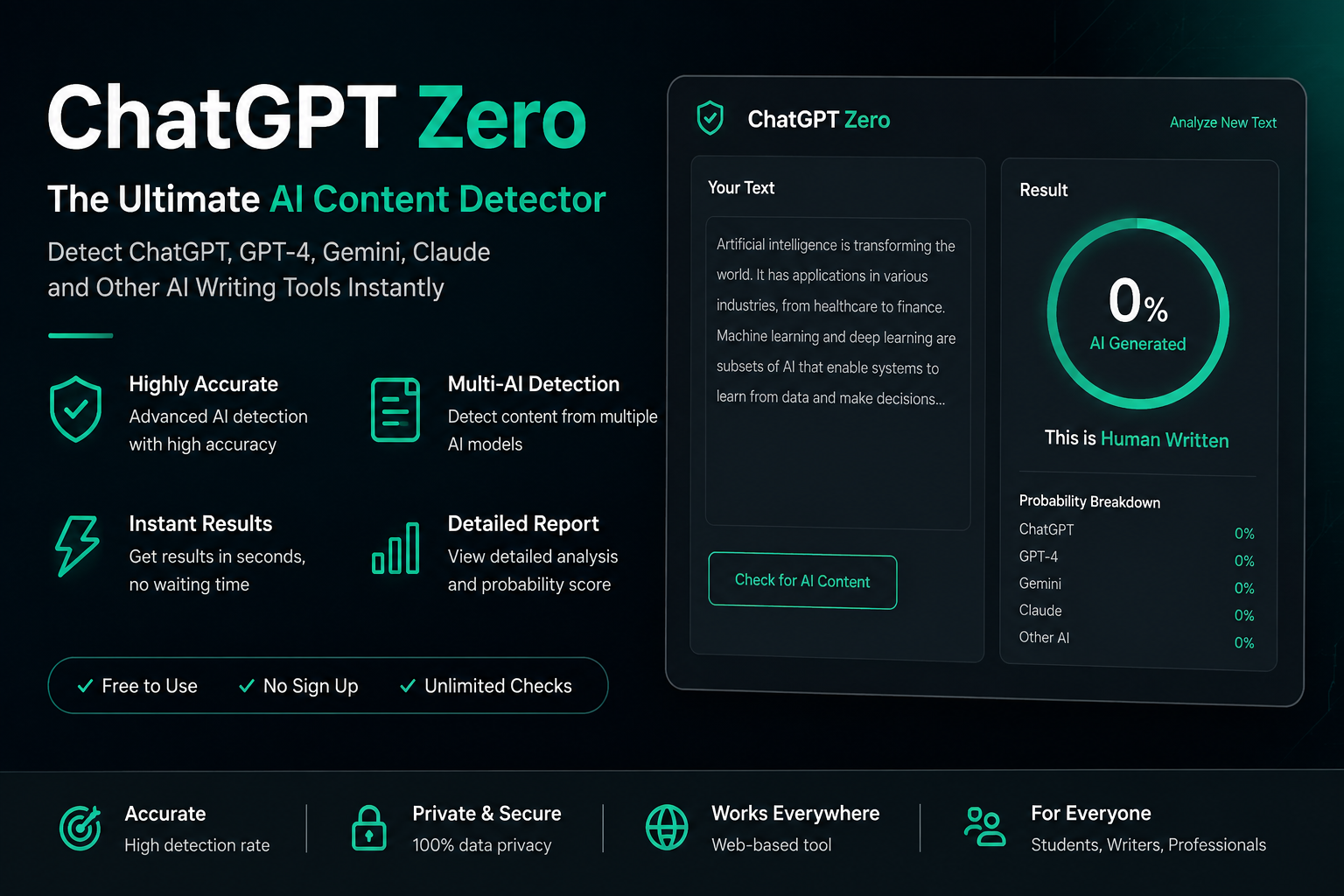
If you searched for ChatGPT Zero, you may be wondering whether it is a version of ChatGPT, an AI writing tool, or something completely different. In most cases, the term refers to GPTZero, an AI detector designed to analyze text and estimate whether it was generated by an AI model such as ChatGPT.
That distinction matters. ChatGPT creates content, while GPTZero analyzes content that has already been written. GPTZero says its system can evaluate text at the document, paragraph, and sentence levels.
However, an AI detector is not a magic authorship machine. Its result is a prediction based on patterns in text, not definitive proof of who wrote it. That makes it important to understand both what ChatGPT Zero can do and where its limitations begin.
What Is ChatGPT Zero?
“ChatGPT Zero” is commonly used as a search phrase for GPTZero, an AI content detector. It is not the name of a zero-cost or special version of ChatGPT.
GPTZero is built to identify text that appears to have been produced by large language models. Its current technology uses deep learning and sentence-level classification to assess the likelihood that text was AI-generated.
The simplest way to understand the difference is:
ChatGPT: Generates and responds to text.
GPTZero: Analyzes existing text for signals associated with AI generation.
AI detector: The broader category that includes tools such as GPTZero and other detection platforms.
This distinction is useful because many searches use “ChatGPT Zero,” “ChatGPTZero,” and “GPTZero” interchangeably.
ChatGPT vs GPTZero: What's the Difference?
So, if someone asks, “How do I check whether my article was written by ChatGPT?” they are generally looking for an AI detector, not ChatGPT itself.
How Does ChatGPT Zero Detect AI-Generated Text?
Modern AI detectors don't simply search for a hidden “ChatGPT signature.” Instead, they analyze characteristics of text and use trained models to estimate whether the writing resembles AI-generated material.
GPTZero says its current system uses an end-to-end deep-learning approach trained on human-written and AI-generated datasets from areas such as education and web content. It also uses a sentence classifier to estimate AI probability and confidence.
Deep-learning analysis
The detector is trained to recognize patterns associated with different types of writing. Because AI models continually change, detection systems also need to evolve.
This is one reason older explanations of AI detection can become outdated quickly.
Sentence-level classification
Rather than treating every document as one giant block, GPTZero can identify individual sentences that contribute to an AI prediction. This gives users more context than a simple “AI: 80%” number.
Document-level analysis
Longer documents can provide more information for a classifier to evaluate. GPTZero says its accuracy generally improves as more text is submitted, with document-level classification being stronger than paragraph- or sentence-level classification.
Mixed human and AI writing
Modern content is not always completely human or completely AI-generated.
For example, imagine a writer creates an article introduction themselves, asks ChatGPT to draft two sections, and then manually edits the entire piece.
That's a mixed document, and GPTZero's current system includes mixed classifications rather than forcing every document into only “human” or “AI.”
How to Use ChatGPT Zero or GPTZero
Using an AI detector is generally straightforward.
Step 1: Prepare the content
Choose the article, essay, paragraph, or document you want to evaluate.
For meaningful results, avoid judging an entire document from a tiny sentence or isolated phrase.
Step 2: Paste or upload the text
GPTZero allows users to paste text or upload supported files for analysis. Its documentation says the tool returns an overall detection result and sentence-level highlighting.
Step 3: Run the analysis
Start the detection process and wait for the results.
The tool may provide an overall classification along with additional information about individual sections.
Step 4: Review the result instead of just the percentage
This is important.
Don't look at one number and immediately conclude that the document was written by AI. Read the explanation, confidence information, and highlighted sections.
Step 5: Investigate unusual results
If a human-written article receives a surprisingly high AI score, review the document's writing history, drafts, research notes, and other evidence rather than assuming the detector is automatically correct.
How to Read a ChatGPT Zero Result
AI detector results can be confusing if you treat every percentage as a factual statement.
GPTZero explains that its AI percentage represents the model's probability prediction, while its confidence level indicates how certain the system is about its classification.
A simplified interpretation looks like this:
For example, a high AI probability does not mean “the software watched this person use ChatGPT.” It means the text resembles patterns the detector associates with AI-generated writing.
That difference is crucial.
How Accurate Is ChatGPT Zero?
There is no single accuracy percentage that applies to every article, language, writing style, AI model, and editing process.
GPTZero publishes its own benchmarking data. In a February 2026 benchmark, the company reported results across multiple domains, models, and languages and compared its system with several commercial detectors. Because these are GPTZero's own published benchmarks, they should be treated as vendor-reported performance rather than universal proof of accuracy in every real-world situation.
GPTZero also says that AI detection is probabilistic and that no detector should be treated as 100% accurate.
The practical takeaway is simple:
Use an AI detector as evidence to investigate, not as an unquestionable verdict.
Can ChatGPT Zero Make Mistakes?
Yes. AI detectors can produce both false positives and false negatives.
False positives
A false positive occurs when human-written content is incorrectly classified as AI-generated.
This matters particularly in education. A student could write an essay independently but still receive an AI-related score because the writing contains patterns that resemble text in the detector's training data.
GPTZero itself acknowledges that human text can sometimes be classified as AI and recommends that educators use detector results as one part of a broader assessment.
False negatives
A false negative occurs when AI-generated content is classified as human.
This can happen because AI systems evolve, writing can be edited, and detection models do not have perfect knowledge of every possible text-generation process.
Short content can be harder to evaluate
A few sentences provide less information than a full document. GPTZero says its accuracy generally improves with longer submissions.
This is another reason not to make major decisions based on a short snippet alone.
Can ChatGPT Zero Detect AI-Edited Content?
AI-assisted writing makes detection considerably more complicated.
Consider four scenarios:
A person writes everything manually.
ChatGPT generates the entire article.
A person writes an article and uses AI only for grammar improvements.
ChatGPT generates the article and a person heavily rewrites it.
These are not identical situations.
GPTZero states that its classifier has limitations when AI-generated text has been heavily modified, and its current system also attempts to account for more complex human/AI editing patterns.
This is why a detector result should be interpreted alongside the actual writing process.
GPTZero vs Other AI Detectors
If you're researching a ChatGPT zero blog, you will likely encounter several other tools.
Features, pricing, supported models, and detection performance can change, so compare the current product information before choosing a tool.
Also, don't assume that five detectors giving different scores means one must automatically be correct. Different systems use different models, datasets, thresholds, and evaluation methods.
Who Should Use ChatGPT Zero?
Students
Students can use an AI detector to understand how their writing may be classified, but they should also retain drafts, notes, citations, and version history.
If a school has an AI policy, that policy should take priority over any generic detector score.
Teachers
Teachers can use AI detection as one signal when reviewing unusual work. However, GPTZero itself advises against using its result alone as the basis for punishment or disciplinary decisions.
SEO writers
SEO professionals can use AI detection as part of a broader editorial workflow. However, AI detection should not replace fact-checking, originality checks, expert review, or search-intent analysis.
Publishers and businesses
Organizations can use detection tools to establish content-review processes, especially when managing large volumes of outsourced or AI-assisted material.
The key is consistency: define what AI use is acceptable before judging content.
What Should You Do If Your Content Is Flagged as AI?
Don't immediately rewrite everything.
Instead:
Review the detector's confidence level.
Check the highlighted sections.
Compare the result with other evidence.
Review drafts and document history.
Check the applicable AI-use policy.
Keep research notes and source material.
Ask for human review when the result has meaningful consequences.
For students and professional writers, maintaining a record of how the document was created can be more useful than trying to make a detector produce a particular score.
Is ChatGPT Zero Free?
Many AI detectors offer some form of free checking, although limits, file sizes, account requirements, and advanced features can vary.
GPTZero currently advertises a free AI detector, while additional functionality is available through its broader platform.
Always check the current pricing page before relying on a particular feature because AI tools frequently change their plans and usage limits.
Does a ChatGPT Zero Score Prove Someone Used AI?
No.
An AI detector predicts whether text resembles AI-generated writing. It does not independently observe the author's writing process.
For that reason, a high score should not automatically be interpreted as proof that someone used ChatGPT.
GPTZero explicitly describes AI detection as probabilistic and says detection results should not be used as the only evidence for academic punishment or discipline.
This distinction is especially important when the consequences of a false accusation are serious.
Best Practices for Responsible AI Detection
The most reliable approach is to combine automated detection with human judgment.
For educators, consider writing history, drafts, classroom performance, and direct discussion.
For publishers, combine AI detection with fact-checking, plagiarism checking, editorial review, and source verification.
For writers, maintain drafts and version history and understand the AI policy that applies to your work.
And if you are using an AI detector, remember that its job is to identify signals, not to reconstruct the entire history of a document.
Frequently Asked Questions
What is ChatGPT Zero?
ChatGPT Zero is commonly used as a search term for GPTZero, an AI detector that analyzes text for patterns associated with AI-generated writing.
Is ChatGPT Zero the same as GPTZero?
In most searches, “ChatGPT Zero” is being used to refer to GPTZero or an AI detector for ChatGPT-generated text. GPTZero is the established product name.
Can ChatGPT Zero detect AI-generated content?
Yes. GPTZero is designed to analyze text and estimate whether it was generated by an AI model such as ChatGPT.
Can GPTZero falsely flag human writing?
Yes. GPTZero acknowledges that false positives can occur, which is why detector results should be interpreted alongside other evidence.
How accurate is GPTZero?
Its performance varies by text and testing conditions. GPTZero publishes benchmark results, but no AI detector should be considered universally or perfectly accurate.
Can GPTZero detect mixed human and AI writing?
Yes. GPTZero's current system includes a mixed classification for documents containing both human and AI writing signals.
Is ChatGPT Zero free?
GPTZero currently offers a free AI detector, although usage limits and advanced features can vary by plan.
Conclusion
ChatGPT Zero is best understood as a search term commonly associated with GPTZero and AI-content detection, rather than as a separate version of ChatGPT. The technology can be useful for reviewing whether writing contains patterns associated with AI generation, but its results should always be interpreted carefully.
The biggest mistake is treating an AI detector score as absolute proof. Writing is increasingly produced through a mixture of human creativity, AI assistance, editing, and research. A responsible workflow therefore combines AI detection with context, writing history, fact-checking, and human judgment.
Whether you're a student, teacher, SEO writer, publisher, or business owner, the goal shouldn't simply be to get a particular detector score. The goal should be to understand how the content was created, whether it is accurate and original, and whether it meets the standards that matter for your audience.
Leave a Reply