

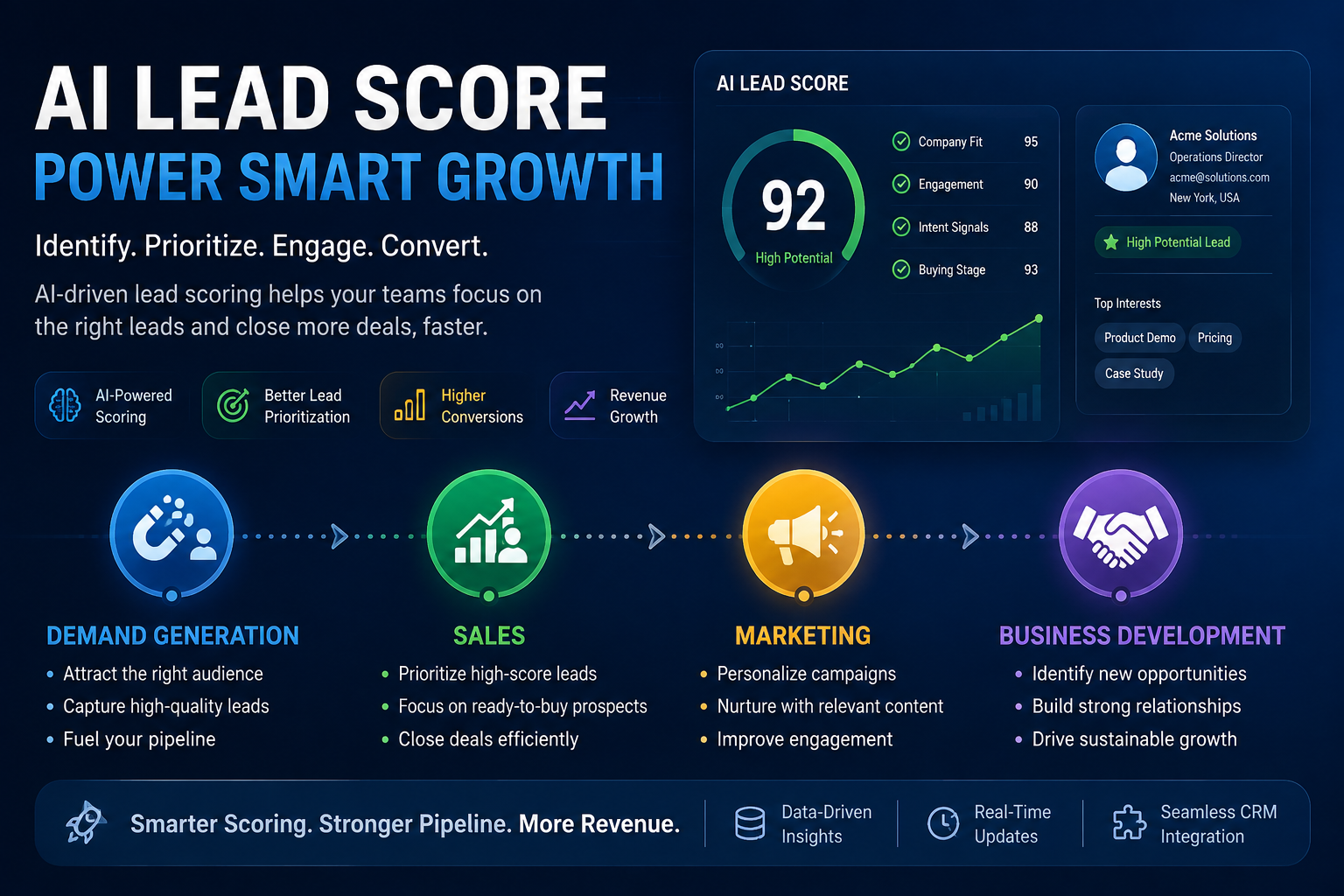
In today's competitive B2B landscape, generating leads is no longer the biggest challenge—identifying which leads are most likely to convert is. Sales and marketing teams often spend valuable time pursuing prospects who have little buying intent, while genuinely qualified opportunities slip through the cracks. This is where artificial intelligence (AI) transforms the entire revenue process.
AI-powered lead scoring helps businesses analyze customer behavior, engagement patterns, firmographic data, and buying signals to prioritize the most valuable prospects. Combined with AI-driven demand generation, sales automation, and business development strategies, organizations can shorten sales cycles, improve conversion rates, and maximize marketing ROI.
Whether you're a startup looking to build a scalable sales process or an enterprise optimizing revenue operations, understanding how AI integrates lead scoring, demand generation, sales marketing, and business development is essential for sustainable growth.
In this guide, you'll learn how AI lead scoring works, why predictive models outperform traditional methods, how AI strengthens demand generation, and which tools can help your team generate better-qualified leads.
What Is AI Lead Scoring?
AI lead scoring is the process of using artificial intelligence and machine learning to evaluate potential customers based on their likelihood of becoming paying clients. Instead of relying on fixed scoring rules, AI continuously analyzes large volumes of customer data and updates lead scores in real time.
Unlike traditional scoring methods that assign points manually, AI identifies hidden patterns across customer interactions, making lead qualification more accurate and scalable.
How AI Lead Scoring Works
AI collects and evaluates information from multiple sources, including:
Website visits
CRM records
Email engagement
Social interactions
Content downloads
Webinar attendance
Purchase history
Sales conversations
Third-party intent data
Machine learning algorithms compare these behaviors with historical conversion data to predict which leads are most likely to become customers.
For example, if previous customers typically visited pricing pages, downloaded case studies, and opened multiple sales emails before purchasing, AI recognizes similar behavior in new prospects and assigns higher scores automatically.
This dynamic approach enables sales representatives to focus on high-intent leads rather than relying on guesswork.
Traditional Lead Scoring vs AI Lead Scoring
Organizations using Predictive lead scoring often experience improved lead prioritization because AI evaluates thousands of data points that manual systems cannot process efficiently.
Understanding AI Demand Generation
Demand generation focuses on creating awareness, attracting potential buyers, nurturing relationships, and moving prospects toward a purchasing decision. AI enhances every stage of this process by making campaigns more personalized and data-driven.
Instead of sending identical marketing messages to every prospect, AI helps businesses understand individual interests and buying behaviors.
How AI Improves Demand Generation
AI supports demand generation by:
Identifying high-value audience segments
Predicting buyer intent
Optimizing advertising campaigns
Personalizing website experiences
Automating email marketing
Recommending relevant content
Improving campaign performance through continuous learning
For example, an AI platform can identify visitors who repeatedly compare pricing pages and automatically enroll them in a personalized email sequence with customer success stories and product demonstrations.
This level of automation improves engagement while reducing manual marketing effort.
How AI Connects Sales, Marketing, and Business Development
One of AI's biggest advantages is its ability to eliminate departmental silos.
Instead of marketing generating leads that sales later rejects, AI creates a unified system where both teams work from the same customer intelligence.
A simplified workflow looks like this:
Marketing Campaigns
↓
Lead Capture
↓
AI Data Collection
↓
AI Lead Qualification
↓
Lead Score Assignment
↓
CRM Integration
↓
Sales Representative Follow-up
↓
Business Development
↓
Closed Revenue
This alignment improves communication between marketing and sales while increasing overall pipeline efficiency.
Business development teams also benefit because AI identifies companies with strong buying intent, allowing representatives to prioritize outreach efforts more effectively.
AI Lead Scoring Models Explained
Different businesses require different scoring approaches. Modern AI platforms often combine multiple models to achieve the highest accuracy.
Rule-Based Lead Scoring
This traditional approach assigns points based on predefined actions.
Example:
Downloading an eBook = 10 points
Visiting the pricing page = 20 points
Opening three emails = 15 points
Although easy to implement, rule-based scoring cannot adapt to changing customer behavior.
Predictive Lead Scoring
Predictive models analyze historical customer data to estimate future conversion probability.
Rather than assigning arbitrary points, AI identifies behaviors that consistently lead to successful sales.
This approach improves forecasting accuracy and helps sales teams prioritize opportunities more effectively.
Many businesses using Predictive lead scoring HubSpot capabilities integrate historical CRM data with AI insights to automate qualification.
Behavioral Lead Scoring
Behavioral models evaluate customer engagement, including:
Website activity
Video views
Product demonstrations
Webinar participation
Email interactions
Live chat conversations
Highly engaged prospects naturally receive higher lead scores.
Intent-Based Lead Scoring
Intent scoring measures buying signals from both first-party and third-party data.
Common signals include:
Competitor research
Industry keyword searches
Product comparisons
Pricing page visits
Review website activity
Intent data helps identify prospects actively researching purchasing decisions.
Generative AI Lead Scoring
Newer AI systems use generative AI to summarize customer interactions, recommend next actions, and explain why leads receive particular scores.
Instead of simply displaying a numerical value, AI can provide insights such as:
"This prospect has a high probability of purchasing because they visited the pricing page three times, attended a webinar, downloaded implementation guides, and belong to your ideal customer profile."
Key Factors AI Uses to Score Leads
AI evaluates numerous variables simultaneously, creating a far more complete picture than manual scoring systems.
Together, these data points create a dynamic lead profile that becomes more accurate over time.
Benefits of AI Lead Scoring for Businesses
Organizations adopting AI-powered lead scoring often achieve measurable improvements across sales and marketing operations.
Key benefits include:
Better Lead Qualification
Sales teams spend less time chasing unqualified prospects and more time engaging buyers with genuine purchase intent.
Higher Conversion Rates
Accurate prioritization means representatives contact the right prospects at the right time.
Faster Sales Cycles
AI reduces delays by identifying sales-ready leads immediately after key buying behaviors occur.
Improved Marketing ROI
Marketing budgets become more efficient because campaigns focus on audiences most likely to convert.
Increased Sales Productivity
Automated qualification eliminates repetitive manual work, allowing representatives to focus on relationship building.
Enhanced Customer Experience
Prospects receive personalized communication based on their interests instead of generic marketing messages.
Better Revenue Forecasting
Because AI continuously updates lead quality predictions, management gains more accurate pipeline visibility.
AI Demand Generation Framework
An effective AI-powered demand generation strategy supports the buyer throughout the entire customer journey.
Awareness – AI identifies target audiences and recommends relevant content.
Interest – Personalized campaigns increase engagement through tailored messaging.
Consideration – Predictive models identify high-value prospects based on behavior.
Intent – Buying signals trigger automated lead nurturing and sales notifications.
Evaluation – AI recommends case studies, demos, and comparison content.
Purchase – Sales representatives receive prioritized leads with actionable insights.
Retention – AI monitors customer engagement and identifies upsell or renewal opportunities.
Rather than treating marketing and sales as separate functions, AI creates a continuous revenue generation system that adapts to customer behavior in real time.
Best AI Tools for Lead Scoring and Demand Generation
Selecting the right Lead scoring software depends on your business size, CRM ecosystem, and sales process.
Businesses already using AI lead scoring HubSpot benefit from seamless CRM integration, automated workflows, and predictive insights without requiring extensive technical expertise. Organizations seeking advanced enterprise capabilities often choose Salesforce Einstein for its robust forecasting and AI-driven sales recommendations.
Emerging AI platforms also incorporate Default AI capabilities that automatically analyze customer data, suggest optimal next actions, and reduce the need for manual configuration, making advanced lead scoring accessible to teams of all sizes.
Real-World Use Cases of AI Lead Scoring
AI lead scoring delivers measurable value across industries by helping businesses focus on high-quality opportunities instead of treating every lead the same.
SaaS Companies
Software companies often receive thousands of trial sign-ups every month. AI analyzes product usage, feature adoption, login frequency, and support interactions to identify users most likely to upgrade to paid plans.
Example: A SaaS company prioritizes users who invite teammates, use premium features, and visit the pricing page multiple times, resulting in faster conversions.
Manufacturing
Manufacturers use AI to identify businesses researching equipment, requesting product specifications, or downloading technical documents. Sales teams can then prioritize companies with the strongest buying intent.
Healthcare
Healthcare organizations evaluate webinar participation, consultation requests, and content engagement to determine which prospects are ready to discuss solutions with a sales representative.
Financial Services
Banks and financial institutions use AI to analyze customer interactions, application behavior, and financial profiles to recommend suitable products while improving lead qualification.
Marketing Agencies
Agencies receive inquiries from businesses of varying sizes. AI helps identify prospects with realistic budgets, clear project requirements, and high conversion potential, allowing account managers to focus on profitable opportunities.
Step-by-Step AI Lead Scoring Implementation
Successfully implementing AI lead scoring requires more than installing software. Businesses should follow a structured approach to maximize results.
Step 1: Define Your Ideal Customer Profile (ICP)
Clearly identify the characteristics of your best customers, including:
Industry
Company size
Revenue
Geographic location
Decision-makers
Common pain points
A well-defined ICP improves scoring accuracy from the beginning.
Step 2: Clean Your CRM Data
AI models rely on accurate information. Remove duplicate records, outdated contacts, incomplete profiles, and inconsistent data before training your model.
Step 3: Connect Data Sources
Integrate your CRM, website analytics, email marketing platform, advertising channels, customer support system, and third-party intent data to create a complete customer view.
Step 4: Configure the AI Model
Train the AI using historical customer data so it can recognize patterns associated with successful conversions.
Step 5: Align Sales and Marketing
Marketing and sales teams should agree on what qualifies as a Marketing Qualified Lead (MQL) and a Sales Qualified Lead (SQL). Shared definitions reduce friction and improve follow-up efficiency.
Step 6: Test and Optimize
Monitor scoring accuracy regularly. Compare AI predictions with actual conversion outcomes and refine the model as customer behavior evolves.
AI Lead Score Example
The following example illustrates how AI can improve lead qualification and revenue performance.
Example Scenario
A B2B software company receives 5,000 leads each month.
Using an AI lead score example, the platform analyzes website visits, email engagement, webinar attendance, CRM activity, and buying intent signals.
Instead of assigning static scores, AI identifies the 1,250 leads with the highest likelihood of converting. Sales representatives prioritize these prospects, resulting in more productive conversations, shorter sales cycles, and increased revenue.
Common Mistakes to Avoid
Even advanced AI systems require proper implementation. Avoid these common mistakes to maximize performance.
Poor Data Quality
Outdated or incomplete CRM records reduce prediction accuracy.
Over-Automation
AI should support sales professionals—not replace human judgment. Important opportunities still benefit from personal conversations.
Ignoring Intent Data
Behavioral data alone does not tell the complete story. Combining first-party and third-party intent signals creates more accurate lead scores.
Weak CRM Integration
Disconnected systems prevent AI from accessing the full customer journey.
Failure to Update Models
Customer behavior changes over time. Retraining AI models regularly keeps predictions accurate.
Misaligned Teams
If marketing and sales use different qualification standards, valuable opportunities may be overlooked despite accurate scoring.
Measuring Success with AI Lead Scoring
Tracking the right KPIs helps determine whether your AI strategy is delivering measurable business value.
Reviewing these metrics regularly allows organizations to refine campaigns, improve targeting, and increase long-term profitability.
Future Trends in AI Lead Scoring and Demand Generation
AI continues to evolve rapidly, introducing new capabilities that will reshape sales and marketing strategies.
Autonomous AI Sales Agents
AI assistants will handle prospect research, outreach recommendations, follow-up scheduling, and meeting preparation with minimal human input.
Predictive Revenue Intelligence
Future AI platforms will forecast pipeline performance, identify revenue risks, and recommend actions before opportunities are lost.
Hyper-Personalization
Marketing messages, landing pages, and product recommendations will adapt dynamically to each visitor's behavior and preferences.
Conversational AI
Intelligent chatbots will qualify leads, answer questions, schedule demonstrations, and collect customer insights around the clock.
Real-Time Buying Intent
Businesses will increasingly rely on live behavioral signals rather than historical activity to prioritize prospects.
Revenue Operations (RevOps)
AI will continue bringing together marketing, sales, customer success, and finance teams through shared data and predictive analytics.
Organizations that embrace these innovations early will be better positioned to improve efficiency, strengthen customer relationships, and accelerate sustainable growth.
Conclusion
Artificial intelligence has transformed how businesses approach lead qualification, demand generation, sales marketing, and business development. Rather than relying on static scoring systems and manual processes, organizations can now use AI to evaluate customer behavior, predict buying intent, and prioritize opportunities with remarkable accuracy.
When combined with clean data, aligned sales and marketing teams, and a well-defined implementation strategy, AI lead scoring improves conversion rates, increases marketing ROI, shortens sales cycles, and strengthens revenue forecasting.
Whether you're a growing startup or a global enterprise, adopting AI-powered lead scoring is no longer just a competitive advantage—it is becoming an essential part of building a scalable, data-driven revenue engine.
Frequently Asked Questions
What is AI lead scoring?
AI lead scoring uses machine learning and customer data to predict which prospects are most likely to become paying customers, helping sales teams prioritize high-value opportunities.
How is predictive lead scoring different from traditional lead scoring?
Traditional lead scoring relies on manually assigned rules, while predictive lead scoring analyzes historical data and behavioral patterns to generate dynamic, continuously updated scores.
Can small businesses benefit from AI lead scoring?
Yes. Many modern CRM platforms offer AI-powered lead scoring features designed specifically for small and medium-sized businesses, enabling them to improve lead qualification without large technical teams.
Which CRM platforms support AI lead scoring?
Popular platforms include HubSpot, Salesforce Einstein, Microsoft Dynamics, and several specialized lead scoring solutions that integrate with existing sales and marketing tools.
Does AI replace sales representatives?
No. AI enhances decision-making by identifying high-priority prospects, but successful sales still depend on relationship building, consultative selling, and human expertise.
How often should AI models be updated?
Businesses should monitor performance continuously and retrain models periodically to reflect changing customer behavior, market conditions, and new data sources.
Leave a Reply