

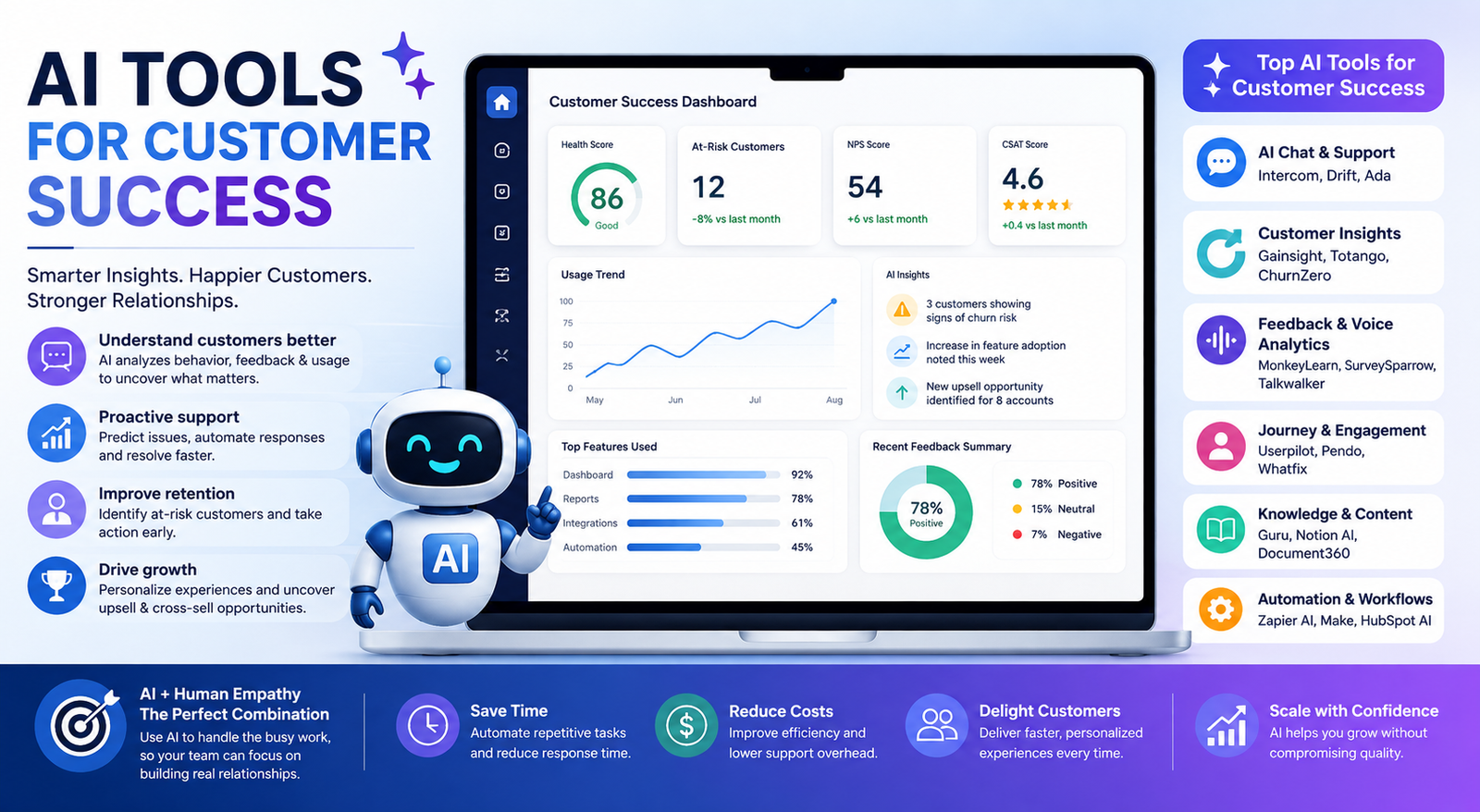
Customer success teams are under constant pressure to do more with less. CSMs need to understand customer behavior, identify churn risks, prepare for meetings, answer questions, update CRM records, and maintain strong relationships—all while managing growing account portfolios.
That is where AI tools for customer success can make a real difference.
Modern AI can summarize customer conversations, identify risk signals, analyze feedback, personalize communication, automate repetitive tasks, and help teams act before a customer becomes disengaged. However, choosing the right platform is not simply about finding the tool with the most impressive AI features. The best option depends on your team's size, workflow, data, budget, and specific customer-success goals.
This guide covers the best AI tools for customer success, including dedicated customer-success platforms, AI assistants, analytics tools, and automation solutions. It also explains how to choose a tool, measure ROI, and use AI without sacrificing the human relationships that make customer success effective.
Quick Comparison of AI Tools for Customer Success
Features, availability, and pricing can change, so verify current details on each vendor's website before purchasing.
What Are AI Tools for Customer Success?
AI tools for customer success are software applications that use artificial intelligence to help customer-success teams understand accounts, automate workflows, predict customer behavior, and improve customer experiences.
Depending on the platform, AI may analyze:
Product usage
CRM records
Customer conversations
Support tickets
Email interactions
Survey responses
NPS and CSAT feedback
Renewal information
Customer sentiment
Engagement patterns
The resulting insights can help a customer success manager decide which accounts need attention and what action should happen next.
Traditional customer-success software often requires teams to manually enter information and interpret dashboards. AI-powered systems can add automated analysis, recommendations, natural-language interaction, predictive signals, and increasingly autonomous workflows.
How AI Is Changing Customer Success
The biggest change is the movement from reactive customer success toward proactive and predictive customer management.
Instead of waiting until a renewal is approaching, AI can help teams identify warning signs earlier.
For example, imagine a SaaS customer whose product usage has declined for three consecutive weeks. At the same time, support conversations contain increasingly negative language and the customer's main stakeholder has stopped attending meetings.
A human CSM might eventually notice these signals. An AI system can bring them together and flag the account much earlier.
AI can help with:
Customer-health monitoring
Churn prediction
Customer onboarding
Automated follow-ups
Sentiment analysis
Meeting summaries
QBR preparation
Customer feedback analysis
Support automation
Expansion opportunity detection
CRM updates
Gainsight, for example, currently positions AI around customer health, risk signals, expansion opportunities, sentiment, and AI agents designed for customer-success workflows.
10 Best AI Tools for Customer Success
1. Gainsight — Best for Customer Health and Retention
Gainsight is one of the strongest choices for organizations that need a dedicated customer-success platform rather than a general AI assistant.
Its AI capabilities can help teams analyze customer information, identify risk and opportunity signals, generate content, and automate customer-success workflows. Its current platform also includes pre-built agents and AI-driven customer intelligence.
Best for: Enterprise customer success
Key uses: Health scoring, retention, expansion, customer intelligence, AI agents
Example: A CSM can use account-level signals to identify customers whose engagement is declining and prioritize outreach before renewal risk becomes critical.
2. Salesforce — Best for CRM-Powered Customer Success
Salesforce is a strong choice for companies that already manage customer data inside the Salesforce ecosystem.
AI can be connected with customer records, service workflows, analytics, and automated processes. For larger organizations, the advantage is having customer information and AI-driven workflows connected within an established CRM environment.
Best for: Enterprise organizations
Key uses: CRM intelligence, automation, service, customer data, AI agents
The major advantage is integration. Instead of forcing CSMs to move between disconnected applications, customer information can remain connected to the workflows where teams already work.
3. Claude — Best AI Assistant for CSM Productivity
Claude can be useful as a general-purpose AI assistant for customer-success professionals.
A CSM can use it to:
Summarize customer notes
Draft follow-up emails
Analyze survey responses
Prepare meeting questions
Turn raw notes into account plans
Analyze qualitative feedback
Create QBR content
It is not a dedicated customer-success platform, so it should be viewed as a productivity layer rather than a replacement for a full CS system.
Best for: Individual CSMs and small teams
Key uses: Research, writing, analysis, summaries, documentation
4. HubSpot — Best for SMB Customer Engagement
HubSpot can be useful for smaller customer-success teams that want CRM, marketing, sales, and customer-management capabilities in a connected environment.
Its AI capabilities can assist with content, customer information, automation, and workflows.
Best for: Small and mid-sized businesses
Key uses: CRM, customer engagement, automation, communication
The biggest benefit is simplicity: teams can combine customer data and AI-assisted workflows without building a complicated technology stack.
5. Zendesk — Best for AI-Powered Customer Support
Zendesk is particularly useful when customer success and customer support are closely connected.
AI can assist with customer inquiries, ticket workflows, routing, self-service, and support-agent productivity.
Best for: Support-heavy organizations
Key uses: Ticket management, AI assistance, self-service, customer service
For companies where support interactions are an important indicator of customer health, connecting support data with CS processes can provide valuable context.
6. Intercom — Best for AI Customer Service
Intercom is another strong option for organizations that want AI-powered customer communication and support.
Its AI capabilities are particularly relevant for:
Customer questions
Self-service
Support conversations
Automated responses
Escalation
Customer education
Best for: SaaS and digital businesses
Key uses: AI customer service, support automation, self-service
7. Gong — Best for Conversation Intelligence
Gong focuses heavily on analyzing customer and revenue conversations.
For customer-success teams, conversation intelligence can reveal:
Customer concerns
Sentiment
Repeated objections
Renewal risks
Action items
Product feedback
Best for: Revenue-focused CS teams
Key uses: Call analysis, customer conversations, insights, follow-ups
This can be especially valuable when important customer information is buried inside dozens of calls and meeting notes.
8. ChurnZero — Best for SaaS Retention
ChurnZero is designed around customer-success management and retention.
It can help teams monitor customer engagement, manage accounts, and identify signals associated with customer health and churn.
Best for: SaaS customer-success teams
Key uses: Retention, customer health, engagement, automation
Its dedicated CS focus makes it more relevant to a customer-success organization than a general-purpose AI assistant.
9. Vitally — Best for Growing CS Teams
Vitally provides customer-success management capabilities for teams that need structured account management, workflows, reporting, and customer intelligence.
Best for: Growing customer-success organizations
Key uses: Account management, customer health, workflows, reporting
It can be a good fit for teams that have outgrown spreadsheets but do not necessarily need an extremely complex enterprise implementation.
10. Notion AI — Best for Customer Documentation
Notion AI is particularly useful for customer-success knowledge management.
CSMs can use it to organize:
Customer notes
Meeting summaries
Account documentation
Internal processes
Customer research
Success plans
Best for: Small and mid-sized teams
Key uses: Documentation, summaries, knowledge management
It works especially well when the biggest problem is scattered information rather than sophisticated churn prediction.
Best AI Tools for Customer Success by Use Case
The “best” tool depends heavily on the job you need it to perform.
Best AI Tools for Customer Onboarding
Look for tools that can automate onboarding tasks, personalize customer education, identify stalled accounts, and trigger follow-ups.
For example, if a new customer has not completed an important setup step after seven days, an automated workflow could alert the CSM or send appropriate educational content.
Best AI Tools for Churn Prediction
Churn prediction tools analyze customer signals that may indicate declining engagement.
Useful signals can include:
Reduced product usage
Negative support interactions
Missed meetings
Lower engagement
Renewal timing
Customer feedback
Remember that an AI churn score is a decision-support signal, not a guaranteed prediction. CSMs should validate important recommendations against actual customer context.
Best AI Tools for Customer Health Scoring
Traditional health scores often rely on a limited number of metrics.
AI can potentially bring together broader information, including product activity, support history, communication patterns, sentiment, and account information.
That creates a more complete picture of customer health—but only when the underlying data is accurate.
Best AI Tools for Customer Support
If support generates a large amount of customer information, AI can help classify tickets, suggest responses, identify recurring problems, and route conversations.
This information can also become useful to customer-success teams because repeated support problems may indicate adoption or retention risks.
Best AI Tools for Customer Feedback Analysis
AI can analyze large volumes of:
NPS responses
CSAT feedback
Reviews
Support tickets
Call transcripts
Feature requests
Instead of manually reading hundreds of responses, a CSM leader can identify recurring themes and prioritize the problems appearing most frequently.
Free AI Tools for Customer Success
Not every team needs an expensive customer-success platform.
AI tools for customer success free options can be useful for basic tasks such as:
Email drafting
Meeting summaries
Customer research
Data analysis
QBR preparation
Documentation
Feedback categorization
General AI assistants can provide significant value for individual CSMs. However, free tools generally do not replace a dedicated customer-success platform when you need persistent account data, automated health scoring, advanced integrations, permissions, or enterprise governance.
A practical approach is to start with a free or low-cost AI assistant, prove that a workflow saves time, and then consider investing in specialized software.
AI Tools for Customer Success by Team Size
Small teams
Prioritize affordability and ease of use.
A combination of an AI assistant, CRM, meeting tool, and simple automation platform may be enough.
Mid-market teams
Look for:
Customer-health scoring
CRM integration
Automated workflows
Support integration
Account analytics
Customer segmentation
Enterprise teams
Enterprise organizations should prioritize:
Security
Data governance
Permissions
Scalability
CRM integration
AI-agent controls
Auditability
Data quality
Gainsight, for example, documents AI data-handling and privacy controls for its AI features, illustrating why governance should be part of an enterprise buying decision.
How to Choose the Right AI Customer Success Tool
Before purchasing, answer these nine questions:
What customer-success problem are we trying to solve?
Which repetitive tasks consume the most CSM time?
Where is our customer data stored?
Does the tool integrate with our CRM?
How accurate are its AI recommendations?
Can humans review important AI actions?
What security and privacy controls are available?
How will pricing scale as usage increases?
What measurable business outcome will justify the investment?
Avoid buying software simply because it has an impressive AI label.
Start with a specific problem and a measurable outcome.
How to Measure AI Customer Success ROI
AI adoption should be measured against actual business results.
Useful productivity metrics include:
CSM hours saved
Time spent preparing for meetings
Number of accounts managed per CSM
Administrative time
Customer metrics include:
Retention rate
Churn rate
CSAT
NPS
Onboarding completion
Customer engagement
Revenue metrics include:
Renewal rate
Expansion revenue
Net revenue retention
Customer lifetime value
For example, if AI saves a CSM five hours every week, those hours should not simply disappear. The team can redirect that capacity toward strategic account planning, customer conversations, or expansion opportunities.
Risks and Limitations of AI in Customer Success
AI is powerful, but it is not infallible.
Poor data creates poor recommendations
If CRM records are incomplete, AI may produce misleading conclusions.
AI can hallucinate
Generated summaries and recommendations should be checked before being sent to customers.
Churn predictions can be wrong
A low health score does not automatically mean a customer will leave.
Over-automation can damage relationships
Customers do not want every interaction to feel machine-generated.
Privacy matters
Customer conversations may contain confidential business information. Review how vendors handle data, retention, access, and model training before connecting sensitive information.
AI CSM vs. Human Customer Success Manager
The future of customer success is unlikely to be simply “AI instead of CSM.”
A better model is AI + human expertise.
AI should handle:
Data analysis
Summaries
Drafting
Classification
Repetitive updates
Pattern detection
Alerts
CSMs should own:
Strategic relationships
Negotiations
Difficult conversations
Customer empathy
High-value decisions
Renewal strategy
Business outcomes
The objective is to remove administrative work so customer-success professionals have more time for customers.
Final Verdict
The best AI tools for customer success are not necessarily the tools with the longest feature lists. The right choice depends on your customer data, team size, budget, existing technology, and primary business problem.
For enterprise customer health and retention, a dedicated platform such as Gainsight can make sense. For CRM-centered organizations, Salesforce can provide a connected ecosystem. For individual productivity, general AI assistants such as Claude can handle research, writing, analysis, and documentation.
Start with one measurable use case—such as reducing meeting preparation time or identifying churn signals—then measure the result before expanding AI across the customer-success organization.
FAQs
What are AI tools for customer success?
AI tools for customer success use artificial intelligence to analyze customer data, automate repetitive workflows, identify risks, personalize communication, summarize conversations, and help CSMs make better decisions.
What is the best AI tool for customer success?
There is no single best tool for every organization. Gainsight is a strong option for dedicated customer-success management, while Salesforce can suit companies that want AI connected to their CRM. Individual CSMs may benefit from general AI assistants such as Claude.
Are there free AI tools for customer success?
Yes. Free AI assistants can help with email writing, customer research, meeting summaries, documentation, and feedback analysis. However, advanced health scoring, CRM automation, AI agents, and enterprise controls usually require specialized software.
Can AI predict customer churn?
AI can identify patterns associated with churn risk, including declining usage, negative sentiment, reduced engagement, and support problems. However, predictions should be treated as signals that require human validation.
Will AI replace customer success managers?
AI is more likely to automate repetitive administrative work than completely replace CSMs. Human judgment remains important for relationships, negotiations, strategic decisions, escalations, and complex customer situations.
How does AI help customer success managers?
An AI customer success manager workflow can use AI to prepare account summaries, analyze customer feedback, identify risks, draft emails, summarize meetings, update records, and recommend which customers need attention.
Is AI worth it for a small customer-success team?
It can be, especially when AI addresses a clear bottleneck. Small teams should begin with affordable tools that save measurable time, then expand into specialized customer-success software as their customer base and data requirements grow.
Leave a Reply